Showing posts with label American Fiction. Show all posts

May 22, 2015

Book Review—Lolita by Vladimir Nabokov

Nabokov’s most celebrated and infamous novel. It is the story of Humbert Humbert, a middle-aged literature academic. While staying at the Haze residence to work on a multivolume comparison of French and English writers he meets Dolores, or, as he will come to know her, Lolita: “Light of my life, fire of my loins”. There is however a problem: Lolita is 12 years old, and Humbert goes to extreme lengths to see and hold Lolita, even marrying Charlotte Haze, her mother, whom he despises. Finally possessing that which he desires, Humbert regales through the troubling ‘relationship’, until in the end the already tawdry tale escalates to murder.

Humbert is unrepentant and neither is Nabokov’s prose. On full show are the writer’s love of and skill with striking phrases, puns, literary allusions and transformations that ooze over every line. It is alarming to have such vile subject matter in such incredible prose, and for many this is a stumbling block. It is a peculiarity that erotic elements in literature are often not viewed beyond the surface. It is accepted that Moby Dick is about more than just whaling, or that The Great Gatsby is about more than wild parties and excess in the Jazz Age. But with Lolita the obvious perversion is all some see, with Nabokov’s rich style viewed as an attempt at masquerading a “dirty little book”.

Lolita is best described as the twisted comedy of Humbert, a pompous, vile, self-absorbed unreliable narrator. He has his charms, chief among them his verbose wit, and many more flaws, primarily his misuse of his eloquence. But his is a hilarious, ironic tale of the collision of memory and desire in the mind of a vain wretch.
Andreas

March 25, 2015

TV Review—True Detective Season One by Nic Pizzolatto

Marty Hart (Woody Harrelson) and Rust Cohle (Matthew McConaughey) are part of Louisiana State CID investigating a bizarre murder with occult symbols in 1995. In 2002, after they believe the case closed, they realize that they only scratched the surface, leading all the way to 2012, when a crime with many similarities brings in two new detectives and a difficult reconciliation between Hart and Cohle.


The humidity of Louisiana soaks every scene, and cutting between the three timeline story creates a crucible in which reflections on the past brings it unavoidably into the present. Life becomes a circle where the players are left in a spiral of repetition. McConaughey shines as the philosophical musing Cohle and contrasts well with Harrelson, who plays the morally questionable straight man in the duo.
Well written, supremely acted and perfectly set, True Detective is a prime example of the current Golden Age of Television and one of the greats of the McConaissance.
Andreas

February 20, 2015

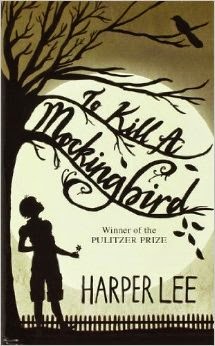
Book Review - To Kill a Mockingbird by Harper Lee

With Harper Lee’s second novel, Go Set a Watchman, due for release later this year, it seemed a perfect opportunity to revisit her original 1962 Pulitzer Prize winner.


Scout Finch lives in Depression struck Maycomb, Alabama, with her widowed father, Atticus, older brother, Jem, and house keeper, Calpurnia. Their childhood ventures during the summer are accompanied by Dill, a neighbour’s nephew. The talk of the town one year is Atticus defending Tom Robinson, a black man accused of raping a white woman. But the children have their own dilemma surrounding Boo Radley, the boogieman of the neighbourhood.
Lee creates the intimacy of a small town through a toy box of tales, collecting spook stories, folk tales, tall tales, and neighbourhood gossip.  But these are not simply exaggerated, occasionally humourous, fictions sung by residents about their fellow citizens. Stories in Maycomb have the ability to console or destroy, to commend or condemn.
Many appraisals of the novel focus on the depiction of race relations, with Tom Robinson becoming the titular mockingbird. But he is one of many in the story. Even his accuser, Mayella Ewell, tries desperately to sing, only to be chocked by her father’s brutal bawl. But the central mockingbird of the tale is Boo Radley, the gentle, generous soul, nested in his house, offering occasional whispered melodies.
To Kill a Mockingbird is both an ode to and living proof of the power of stories to change lives.
Andreas

August 22, 2014

Book Review: Butcher’s Crossing by John Williams

John William’s third novel, Stoner (originally published in 1965), was heralded as a ‘must read’ of 2013. Now, his earlier work, Butcher’s Crossing (1960), is receiving similar treatment, with invocations of Herman Melville as influence and Cormac McCarthy as successor. 


Bostonian Will Andrews travels to Western frontier country, to Butcher’s Crossing, a town, or rather inhabited road, filled with rumoured prosperity and dwindling reality. The economy is based on buffalo hide and the train is said to be coming through. But times are tough, with the buffalo population on its last whispers. Andrews convinces, or is convinced by, Miller, a seasoned hunter, to partake in a tall-tale expedition to a hidden, untouched valley with several thousand head of buffalo. Although promising to be lucrative, for Andrews this is not about money but experience. It is the grand adventure that entices Andrews.

As the expedition continues aggression exacerbates into fatigue, with the negotiations between hatred and dependence, the wild and the controlled, nature and man, becoming the staples of life. The promise of the grand adventure dwindles into the frivolity of reality. Certainly a must read of 2014. 
Andreas.