Showing posts with label History. Show all posts

April 21, 2017

Book Review - 'Seven walks: Cape Leeuwin to Bundeena' By Tom Carment; photography by Michael Wee.


Photographer Michael Wee and painter/writer Tom Carment, have chronicled their experience of some great walks of Australia.
Combining photographs, paintings and words, the book provides anecdotal experience along with the history of the places traversed.  It is nostalgic and full of awe for the wild and varied landscapes that are distinctly Australian.
 

The book has a bit of everything: history, humour and art. You may find things you are familiar with, such as the Coast Walk in NSW, or unfamiliar things such as The Overland Track of Cradle Mountain in Tasmania.
Available here.

May 25, 2015

Book Review—Mapping our World: Terra Incognita to Australia

Who thought a book about cartography could be so captivating? Based on an exhibition by the National Library of Australia, this fascinating book reveals the history of man’s conception of the world.

Showing how cultures perceived their world, the volume starts with the earliest extant map from the Babylonians and progresses through to early maps of Australia. Beautifully reproduced are the maps from these many ages, from the geometrically divided world of the ancients, to the medieval mappaemundi that combined the physical and temporal history of the world, through the mercantile maps of the age of exploration, leading to the early sketches of the Australian continent.


The interest goes further than the physical with the story of how people perceived themselves in their world, their conceptions of time and space, other lands and people. It reveals the peculiarities of these ideas (like the belief that the southern continents were not inhabited by decedents of Noah and therefore not human) as well as expelling our myths of the past (the ancients knew the earth was spherical and not flat). As the maps grow more familiar and detailed, so declines the strangeness of these conceptions of the cultures that produced them. What remains is the intrigue of these notions and the people who conceived them.

Mapping our World proves that cartography is more than just geography. It is culture, belief, humanity.
Andreas

July 01, 2014

Book Review - Seven Elements that have Changed the World by John Browne

The author joined BP in 1966 and ended up as Group Chief Executive from 1995 to 2007. Here he provides a potted history of the seven elements that he has selected as world changers: iron, carbon, gold, silver, uranium, titanium and silicon. This is a very interesting book but one to be read in small stages rather than all in one gulp. His views as an industry insider on coal seam gas are fascinating and it is certainly interesting to hear how the major energy players get to sit down with political leaders to discuss business. It's that important! His exploration of these elements is more than that, however, and full of interesting facts. For example, titanium was first isolated by an English clergyman chemist in 1791 but not put to real use until 1910. Later, when its lightness and strength were used for an aircraft that could fly high and evade radar in the late 50s, they made a frame that had to withstand such high temperatures and consequent large expansion at altitude, that on the ground there were such large gaps that it's fuel tank leaked. Before Silicon Valley, the glass blowers of Murano Island in Venice were so important to the Venetian economy, that any glass blower who left and took their trade secrets would have remaining family members executed in an attempt to frighten them into staying. The Hall of Mirrors at Versailles (1682) was not only a demonstration of vast wealth, it was cutting edge technology in the latest mirror manufacture. And many more stories are of good general interest. Not the most readable book, but it does reward you. Wendy

June 01, 2014

Book Review - The White Princess by Philippa Gregory

I like English history and I like Philippa Gregory but I found this a bit hard going. Her meticulous research is to the fore but this story of Elizabeth of York who married Henry Tudor to provide peace, after the War of the Roses, just seems to drag on in endless worries about the pretender York princes. Probably that is truly what happened, but drama should be life without the boring bits and there were too many left in this one for me! One for the fans only Wendy

April 29, 2014

Book Review - How to create the Perfect Wife: Britain's Most Ineligible Bachelor and his Enlightened Quest to train the Ideal Mate by Wendy Moore

In the eighteenth century, Thomas Day was a radical philosopher poet who rejected the values and social mores of his day. He was rude and unkempt but he inherited a huge fortune and was able to indulge some wild ideas. Rejected by and rejecting society beauties, he sought an unspoilt girl who was physically hardened and stoic, possessed obedience, virtue and practical skills. This was Enlightenment period and his social set included all the fashionable men of literature, science and reason. Aided by his friends, he selected two girls from the Foundling Hospital and set about training up his prospective mate under the guise of apprenticing them to a good career. His friend, Edgeworth, enthusiastically raises his son according to the French philosopher, Rousseau's new child -centred approach, which, when implemented thoroughly turns out a badly behaved unhappy boy, but although somewhat modified, remains a key tenet of today's child-centred approach to education. This fascinating biography of Thomas Day, his friends and his protégés benefits immeasurably from the author's extensive research and understanding of the period. Fashion, love, science, folly, hypocrisy and changing fortunes affect the intrepid cast of characters. True tales are sometimes the most unbelievable! Wendy

April 23, 2014

Book Review - A stitch in time: Heirloom Knitting Skills by Rita Taylor

Non-Fiction reviewed by Wendy This is a very easy to read and use guide, explaining the origin of stitches and placing knitting squarely in the 21st century. Divided into Textured, Twisted, Raised, Cable and Lace Stitches and Colourwork, each section provides an exploration of the history and usage around the world. It made sense that Fair Isle and other colourwork patterns not only made use of different coloured wools that may not have been enough for a garment on their own but also provided additional warmth with the additional layers of wool carrying under the pattern. From the warmth and practicality of working jumpers, to the luxury of lightweight lace work, each section includes a comprehensive stitch listing, for example, 34 lace stitch patterns are included. Twelve complete project patterns covering each of the sections including a Fairisle sweater, a lacy shawl, a bobble hat and a cable cardigan enable you to put these heirloom skills into modern-day practice. I very much liked a baby blanket made in squares with a raised leaf pattern and a blackberry stitch border and it may have given me confidence to try a fair-isle pattern – which became popular after Edward, Prince of Wales, appeared wearing one in a magazine in the 20s!

March 14, 2014

Book Review - A History of Food in 100 Recipes by William Sitwell

This is much more of a history book than Who put the Beef into Wellington? Sitwell, a British TV and magazine foodie goes back in time to identify when foods first emerged and the historical contexts. Bread, porridge, roast beef, tomato sauce, oatmeal cookies and ice-cream sodas are a small fraction of what is covered. Including fragments from the earliest known writing about the dish, Sitwell's purpose isn't to help you cook it, but to appreciate its history. Find out why the tomato was viewed with great suspicion in Europe to begin with - apart from anything else, The Axtecs ate them but they also ate people…. , but it went on to be one of the essential ingredients of many cuisines. I found this a fascinating but slow read – a few chapters at a time. Be warned with both of these two food books you will experience a great need to read bits aloud to your nearest and dearest! Wendy

December 27, 2013

Book Review - Beseiged: siege Warfare in the Ancient world by Duncan B. Campbell

This informative volume charts the development of strategies and equipment used in besieging towns and cities in the classical worlds of Greece and Rome. Ancient texts, archaeological finds and modern re-constructions of war engines are used to explain when and how they were used. Famous generals such as Hannibal, Julius Caesar and Alexander the Great feature, with descriptions of their successful and unsuccessful attempts to subdue fortified towns. It was quite important for towns to defend themselves, because if they fell, the men were generally killed and the women and children enslaved by the victors. Filled with illustrations and extensively annotated. Wendy

December 08, 2013

Book Review - 1356 by Bernard Cornwell

The English and the French are engaged in the Hundred Years War and the English are using their deadly weapon – the long bow- to good advantage. Cornwell hits the mark with another of his muscular historical novels. Mixing in a little religious mystique with full blown battles where you can almost smell the sweat and the blood, this one has an intriguing story amongst the grunt. You can feel the years of training and the strength it takes to wield the long bow. Training that must begin in youth and continue as adult stature is reached. Looking after your bow was one thing but a successful army also needs strategy, as well as supplies of arrows and food and all the logistical supports. The story races along, buoyed by meticulous attention to detail and crafted by a master storyteller. Wendy

November 05, 2012

Book review: The Season of the Beast

The Season of the Beast (The Agnes De Souarcy Chronicles by Andrea Japp)


This is the first in a series of historical mysteries about a young widow in medieval France. It has been translated from French, but is nevertheless a beautiful book to read if you don’t mind confusing narratives. I confess I skimmed over the many subplots and historical references I wasn’t sure of, because the characters and places described in between were very interesting. In particular Agnes De Souarcy is a strong character partly because she is depicted in such glowing terms as a renaissance woman and partly because she remains vulnerable in spite of her ample ability and intelligence. What was fascinating also were the various social skills and hazards of France in 1304, which are so different to those we use today. The historicity of these I found convincing, and made this book a worthwhile read. I read it very quickly, and due to a cliffhanger ending will now need to read the second and perhaps third in the series.

Amy

September 14, 2011

Eat History Booklist


All energised by the great foody events of Eat History Week? Our local studies librarian has compiled the following list to inspired!

1. Walkabout chefs : a fresh look at Aboriginal bush food by Steve Sunk and David Hancock


8. It's disgusting-- and we ate it! : true food facts from around the world-and throughout history! / by James Solheim ; illustrated by Eric Brace.

9. The medieval kitchen : recipes from France and Italy / Odile Redon, Franicoise Sabban, Silvano Serventi ; translated by Edward Schneider ; original drawings by Patricia Glee Smith.

10. A taste of history : the stories behind our favourite foods / Bryan Bruce.

11. The Fascinating history of your lunch / Jackie French ; illustrated by Judith Rossell.

December 01, 2009

History - epics, chronicles, romances and inquiries.

"He is the extreme case of a highly recognisable type in many ages: a brilliant, arrogant aristocrat with political ambitions and considerable eloquence and ability."
No, it's not Malcom Turnbull in 2009, it's Alcibiades in 415BC Athenian society as reported in A History of Histories by John Burrow (p. 45).
A review on LibraryThing appears here. Over 200 members of LibrayThing have given this book an average of 4 stars and I would agree with them. This book is an overview of who has written history from the earliest records to the present day; why they wrote it and why it matters what was going on around them when they did. Scholarly and informative, the author's wry humour leavens what can inevitably turn a little dry. I have enjoyed it in instalments and also secure in the knowledge I was reading just for my own pleasure - not to face a test! If you like history you may well get a lot out of this book.
Wendy

November 24, 2009

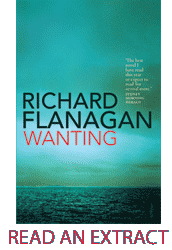
Wanting


This wonderful book has been recognised with several awards/nominations. It won the 2009 Queensland Premier's Literary Award for Fiction, is one of the 2009 Books Alive 50 Books You Can't Put Down and was also one of the shortlisted fiction titles in the 2009 Prime Minister's Literary Awards. In spite of all that, you might want to give it a try - you won't find it wanting (sorry for the bad pun). To find out more about the book, go to Richard Flanagan's website which has reviews, book club notes etc. The story intertwines Charles Dickens and Sir John Franklin, a polar explorer, with the story of Tasmania's aboriginal peoples and their interaction with white settlers in colonial times through the experience of an orphan girl, Mathinna. Sensitive, evocative prose and a masterly weaving of the disparate stories make a fine and thoughtful experience for the reader.
Wendy

Jane Austen's Sewing box


A simple pleasure for Jane fans, craft fans and social history fans. The author has trawled Jane's novels and personal papers to identify craft activities and designed simple projects to illustrate the idea. The background is given in extracts from these papers. The sewing instructions do, I think, presume a level of sewing knowledge as some of the steps are not clear, however, the book can be read as a delicious journey into Jane Austen's world without any intention of actually doing the craft . Step back into time with relish .... then come forward and say thankyou for modern sewing machines etc and not having the responsibility of providing all your family's clothing by hand! Very pretty.

Wendy

August 06, 2009

Devil's Brood


Sharon Penman has delivered an enthralling power play as Henry II and his fascinating wife, Eleanor of Acquitaine, deal with their 'devil's brood' growing up in her final volume of her trilogy on this the original power couple! Their 5 sons who include Richard the Lionheart and Prince John (of Robin Hood infamy) grow to manhood struggling to be recognised by their controlling father and to carve out their own destiny as Kings, Dukes and Counts in England and France. This is a long book - over 700 pages but the story rockets along as Henry deals with the aftermath of the murder of Thomas Beckett and the necessity to keep all his vassals in order. Sharon Penman does extensive research and adds notes explaining why she makes the choices she does when the historical record is not clear. Her website is also a source of good information on the period and her processes in writing historical fiction. As well as 'straight' historical fiction, she writes medieval mysteries which you will find in our Mysteries genre. I took a while to read this simply because the book is quite heavy - and I found it too heavy to read in bed but it's a great read so give it a go!
Wendy

April 25, 2009

The Wisdom of Birds

Subtitled "An Illustrated History of Ornithology", this is a detailed book full of surprising knowledge. Starting with Aristotle, through the ages, men (mostly men) have studied and written about bird biology and behaviour. In the early days of modern academic study, the scientific men were dismissive of the vast store of knowledge built up by amateur bird watchers and bird keepers but as time went by, this knowledge was synthesised and led to much greater understanding. I found the historical insights of most interest.
Why was an egg-laying cockerel burnt at the stake?
Which of Mozart's compositions was based on the song of his pet starling?
How was the role of bird song and plumage display interpreted over the years?
How did they eventually discover that some birds migrated and didn't actually spend the winter hibernating at the bottom of frozen ponds?
All wrapped up with a discussion on how scientific thought and process generally developed and affected the study of birds especially the great legacy of Charles Darwin - Natural Selection.
You can learn a lot (even if , as I did, you skip some of the more technical explanations) and also enjoy the reproductions of illustrations from famous historical bird texts.
Wendy

March 27, 2009

Cook's Endeavour Journal : the inside story

This charming little book takes all the work out of research and presents you with choice bits of information, facsimiles & transcripts of actual written records and reproductions of artwork from precious original items held by the National Library of Australia. While we go about our daily routine, busy people are working with these items and discovering our history and serving it up in these bite size chunks! Less than 180 pages of text and images give a wonderful flavour of Cook's journeys and the achievements of this talented crew which included Banks and Solander. The portions of transcripts are given background and context so we can understand their significance. The original journal is available on line as are the transcripts which is terrific for more in depth research but for a small weekend trip on the bark Endeavour, this beautifully designed book is perfect.
Wendy

March 22, 2009

Azincourt

Bernard Cornwell's masterly recreation of the battle of Agincourt, including the campaign that led up to it is personalised by the focus on Nicholas Hook. Nick has been drawing a bow since he was seven years old, building strength and skill.

"Hook had learned the whispering release that let the string slip through his fingers, which hardened into leather pads. and as he drew and released, drew and released, year after year, the muscles of his back, his chest and his arms grew massive. This was one requirement, the huge muscles needed to draw the bow, while the other, which was harder to acquire, was to forget the eye.
When he first started as a boy, Hook would draw the cord to his cheek and sight down the arrow's length to aim, but that cheated the bow of its full power. If a bodkin was to shear through plate armour it needed all the power of the yew and that meant drawing the cord to the ear, and then the arrow slanted across the eye, and it had taken Hook years to learn how to think the arrow to the target. He could not explain it, but no archer could. He only knew that when he
drew the cord he looked at the target and the arrow flew there because he wanted it to, not because he had lined eye, arrow and target.
That was why the French had no archers other than a few huntsmen, because they had no men who had spent years learning to make a length of yew and a cord of hemp become part of
themselves." ....... from page 134

War in 1415 is brutal and bloody so this book is not for the squeamish. Cornwell's gift for re-telling famous battles and military campaigns evidenced in his works on Wellington (the Sharpe Series) and the American Civil War (the Starbuck Chronicles) is in full flight here. 6,000 Englishmen (including a few Welshmen) beat a French army of 30,000 helped by the weather and the English longbow.

Interestingly, as an aside in his historical note at the end of the book, Cornwell theorises that as the French had threatened to cut off two fingers from the archers' hands to prevent them drawing the bow, that the English made rude gestures with those fingers at the French after they won the battle. Thus the origin of the infamous two fingered salute!

I love Cornwell's masterly evocation of the few men and women he focuses on to tell the story, his commmand of the details of daily life & military training and of course his strong, though flawed, heroes. Visit the author's website for more info on his works http://www.bernardcornwell.net/

Wendy

March 05, 2009

In A Unicorn's Garden - magic and mystery in medieval gardens

A lovely new book to browse or to read in more depth. Find out the characteristics of gardens for alchemists, knights, pilgrims, cooks and more! what were the gardens used for in the context of the medieval times and who looked after them. Loaded with planting information and sample designs as well as photos and stories about re-created gardens you can visit (sadly most are in Europe!) as well as information to help you create your own patch of magic. I was impressed to realise that I had a number of well loved plants that would grace a Mary Garden viz carnations, roses, lavender, rosemary etc. The abiding impression is of the tranquility and serenity of a well-tended and designed garden to soothe the senses and uplift the spirit.
ahh bliss!
Wendy

February 05, 2009

Classic fiction at Narellan Library

We are very pleased to announce that our collection of Classics at Narellan Library has recently been improved with many new titles. New copies of titles by Jane Austen, Charles Dickens, Thomas Hardy, John Steinbeck, Albert Camus, Alexandre Dumas, George Eliot and Victor Hugo and others joined our existing titles. They are now easier to find as the Fiction collections at Narellan have been separated into genre groupings and therefore the classics have their own area of the shelves.
Another new classic title is Mary Shelley's Frankenstein. If you want some background on Mary Shelley, try 'Other People's Daughters: the Life and Times of the Governess' by Ruth Brandon held at Camden Library in the Biography Collection (B 923.7 BRA). both Mary and Claire Clairmont (her step-sister) feature in this exploration of the economic and social history of the governess. It is fortunate that there were some governesses who achieved some celebrity so that their records and papers were kept. Most governesses did not enjoy such a position. The book also includes information on early campaigners for female education and the establishment of the first female colleges at universities in England.
Wendy