Showing posts with label Award Winner. Show all posts

June 23, 2021

James McBride's "Deacon King Kong"


You can find this item here.

The book is set in 1969 in Brooklyn. The plot itself swirls around how a community is affected by a single shooting. Sportcoat (or Deacon King Kong) shoots a young drug dealer, who he used to coach in baseball, for apparently no reason. The time, history, and more importantly the relationships of the its community, police, mobsters and church-goers all work together or against each other in a book that shows the vitality and fragility of that community.

Now, to be honest, I found this book slow in the beginning; but I did feel like it picked up for me after the first few chapters. The style of writing is very lyrical, and that may be why I found it a little slower (particularly since I just came from a Patterson novel where the pace is much faster). However, the characters felt well-rounded and the way McBride intersperses moments of humour with hardship and each character's fate and faith was well done. 

I can see why his book one prizes, like the Andrew Carnegie Medals for Excellence. However, I would suggest that this book is for readers who prefer character-driven and dialogue-driven books as plot and action is second place in this novel. 


Links for you


McBride in the Library:


This title is Fiction.

This title is a biography of James Brown


August 05, 2020

Alvydas Ŝlepikas' "In the shadow of wolves"


This book is originally titled ‘Mano vardas – Marytė’. The translated book can be found here.

Ŝlepikas has written what I would deem a short novel; but definitely not sweet. Before that puts you off, this book was also a Times Book of the Year for 2019, so even if it isn’t gentle, it may be a book to read.

If you do not know this Lithuanian author, he apparently is multi-talented: writing and directing for films; a poet; and a playwright. In this book, he has written an historical work that has been influenced by a couple of ‘wolf children’ themselves who wanted the world to know what it was like for them in post-war Prussia after World War II.

‘In the shadow of wolves’ follows the Schukat family and their lives in Prussia after World War II. It does not follow all their lives equally, and for most of the novel, it focusses on Renate. However, it looks at post-war conditions, issues with World War II, how children feel and survive during these times and what it is like for ‘wolf children’.

As an historical note, and for some background; ‘wolf children’ are children who have found themselves alone in east Prussia and have had to do many things in order to survive. Outside of this novel, if you would like an historical article for reference, you can visit National Geographic’s article here.

The plot may sound very singular, but the focus is on the gritty reality of trying to survive. In fact, it appears this is the most important part of the writing in order to help readers come to know the truth of what post-war situations can be like for children: a part of history that might not be well known by many. If you are looking for in-depth character creation or emotional tugs towards one human protagonist or another, you probably won’t find that here.

Ŝlepikas does not shy away on details of what can happen to humans and humanity during times like those. It is gritty, raw and very, very real. However, it is an important story to tell. As the writer has gone to great lengths to find stories to incorporate into the novel, it also makes it more authentic. If this is too difficult, particularly where it comes to children, probably skip this book.

But people should be aware of such histories.


Links for you:


Usually I do Readers’ Advisory here; however, Ŝlepikas has no other works in our library and there is not, as far as I can find, any nonfiction specifically on the wolf children. So, I have created a list of fiction and, mostly, nonfiction information and biographies that relate to children and their family’s experiences during World War II or afterwards.


Fiction:

Bryan Malessa


Nonfiction:

Anonymous Members of the Kovno Jewish Ghetto Police

Kazimierz Sakowicz and Yitzhak Arad

Julija Šukys

Annette Janic


June 12, 2015

Book Review—Neuromancer by William Gibson


Case is a former computer hacker who stole from his boss and had his central nervous system corrupted by mycotoxin as punishment. Unable to enter the computer matrix that was his source of income and his preferred habitat, he has resorted to hustling in Chiba City, Japan, in the near future where he hopes the black clinics will be able to heal his nervous system so that he can once again enter cyberspace. His hopes are seemingly met when a potential new employer offers to have him healed in exchange for his services.


Neuromancer not only put Gibson on the map but also sparked the cyberpunk subculture in literature, its mix of “high tech and low life” inspiring a host of other writers and film makers. This mingling is most effectively executed with the two worlds Gibson creates. First is the 'real world', a menagerie of the damaged and the predatory, with these often being indistinguishable. This is contrasted with the high tech dream scape of the cyber world where the clutches of the real world are challenged and transformed. But those that traverse the landscapes of this world are the real energy of the novel. These are the new romantics, who bring new life through the electrical impulses of cyberspace and extend these visions into warped reality.

A seminal mindbender, Neuromancer is a world warping thrill ride.
Andreas


November 24, 2009

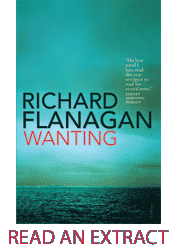
Wanting


This wonderful book has been recognised with several awards/nominations. It won the 2009 Queensland Premier's Literary Award for Fiction, is one of the 2009 Books Alive 50 Books You Can't Put Down and was also one of the shortlisted fiction titles in the 2009 Prime Minister's Literary Awards. In spite of all that, you might want to give it a try - you won't find it wanting (sorry for the bad pun). To find out more about the book, go to Richard Flanagan's website which has reviews, book club notes etc. The story intertwines Charles Dickens and Sir John Franklin, a polar explorer, with the story of Tasmania's aboriginal peoples and their interaction with white settlers in colonial times through the experience of an orphan girl, Mathinna. Sensitive, evocative prose and a masterly weaving of the disparate stories make a fine and thoughtful experience for the reader.
Wendy